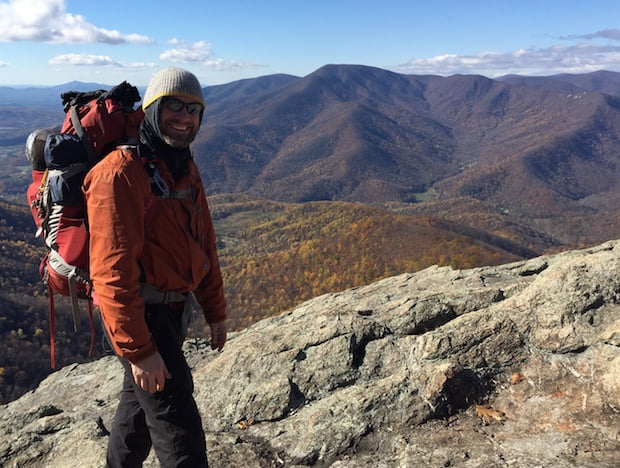
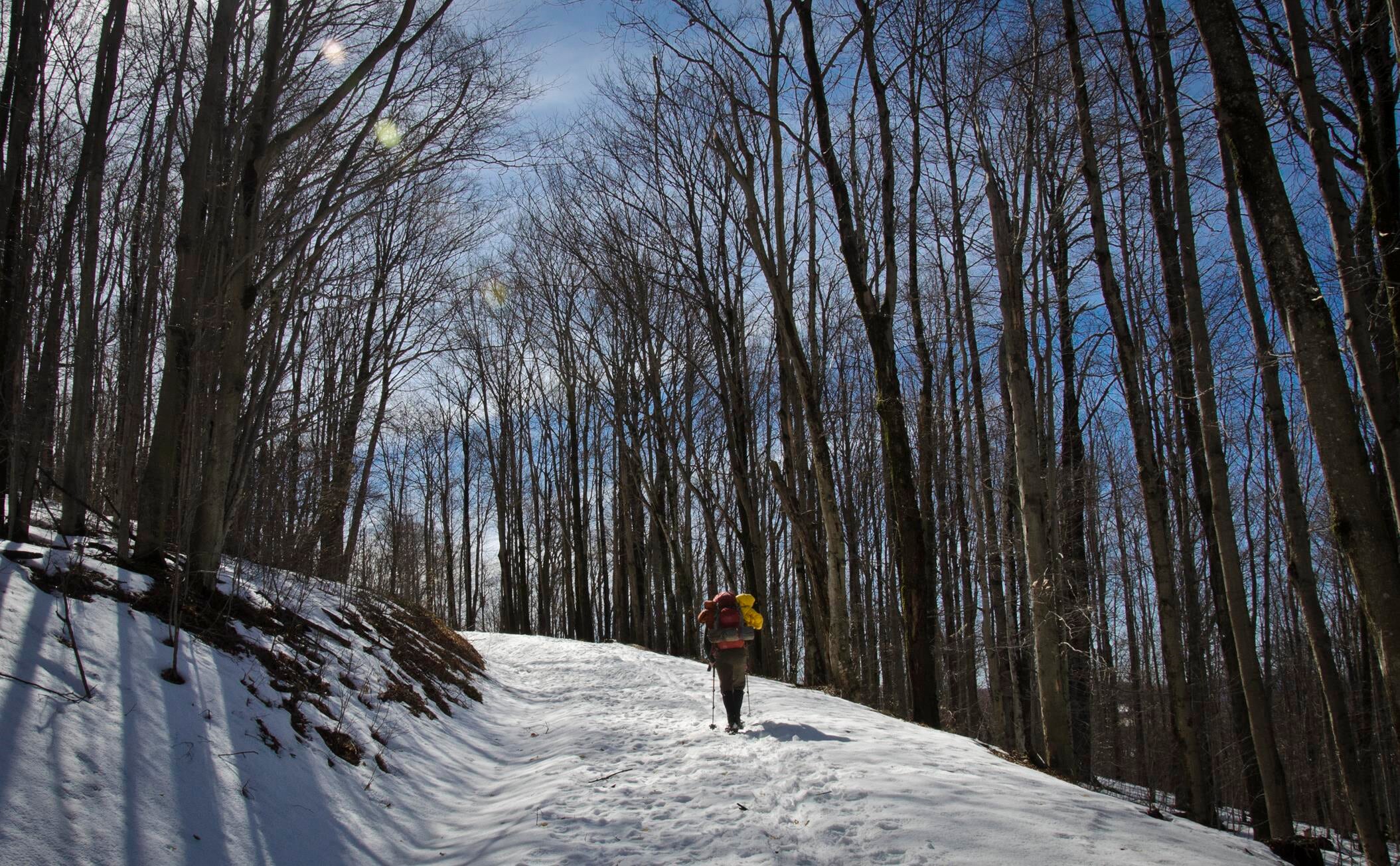
Just past the Northern Knoll of Three Ridges looking at The Priest
I’ve been itching to go backpacking since my July trip to Panthertown Valley. Four months later, and just two months after shoulder surgery, I got to scratch my itch in the Three Ridges Wilderness, located in the George Washington and Jefferson National Forests. My buddy, Coop, mapped out a sweet 20-mile hike with elevations ranging from 1,000′ to 3,790′ at the summit of Three Ridges Mountain.
Atop Little Green Mountain overlooking Panthertown Valley
I’ve been tent backpacking for several years and it wasn’t until a recent trip to Tsali Rec Area that I began to consider the alternatives. A list which includes: on the ground, on the ground with a tarp, or above the ground in a hammock.
I’ve slept on the ground in a sleeping bag. It was fine, but the conditions were ideal (i.e. moderate temps, no bugs, and we were on a bald with little wind). However, I had not crossed off tarp or hammock from my backpacking bucket list.
At Tsali, I noticed a lot of people choosing hammocks over tents. Curious, I asked one camper to let me give their hammock a try. It seemed comfortable enough that I thought I could use a hammock on a future backpacking trip. To the Googles!
Turns out, hammocks aren’t all that expensive. Prices ranged from $40 on up to $200 depending on material. I also found that most backpackers recommended using a bug net, rain fly, and sleeping pad along with a bag, quilt, blanket, or bivy. So let me back up. The hammock is between $40 and $200 while the accessories to keep bugs out, rain off, and heat in will collectively run you an additional $400-$600.
I also took a close look at the weight difference between a tent and a hammock. My REI Quarter Dome T1 tent with footprint, poles, stakes, and rainfly weighs 3 pounds 10 ounces. The ENO DoubleNest Hammock (19 oz), bug net (16 oz), rain fly (22 oz), straps (11 oz), and stakes (2.8 oz) weigh in at 4 pounds 4 ounces. Six ounces isn’t a lot, and in the winter months I’d be 16 ounces lighter since I wouldn’t need a bug net. Plus, factoring in how a hammock packs compared to how a tent packs, I was sold on giving the hammock a chance.
With coupon in hand, I purchased an ENO DoubleNest and the above accessories from the local big box store, and gave it a whirl at a family car camping trip a few days later. Set up was a breeze and sleeping was, in my opinion, better than in a tent. I took the hammock with me on a couple day trips with my son and he loved it as much as I did. The real test, however, would come in an upcoming backpacking trip to Panthertown Valley in the southern Appalachian Mountains.
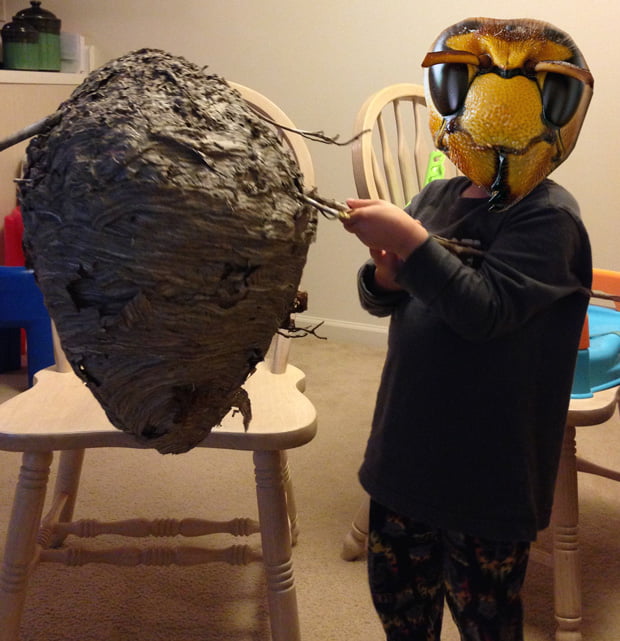
My buddy found this huge hornet (paper wasp??) nest in a bush on his farm. Turns out they’d been mowing next to it for months and neither party noticed the other.
Back in the fall my buddy, John, asked me if I was running Pilot Mountain Payback again. I told him that I would run it provided I was able to train for it. If I learned anything from last year’s adventure it’s that the marathon isn’t really a marathon. It’s a come-to-Jesus journey in which you run up and down a mountain with the hopes that you don’t come to Jesus before you cross the finish line.
Flash forward to the first week of January when I found out I had a kidney stone. Pretty awesome, right? Well, a week later I ran a 15-mile trail race. Pretty smart, right? Over the ensuing few weeks I ran a grand total of 40 miles which averaged out to about “not enough to run a trail marathon” miles per week. That’s when I told John that I wouldn’t be participating.
a hard mass formed in the kidneys, typically consisting of insoluble calcium compounds; a renal calculus (i.e. a pebble in the kidney).
In the past 7 years I’ve had 2 kidney stones. The experiences were painful, but they were quick to resolve. My latest stone was less pleasant, a lot more painful, and took forever to pass.
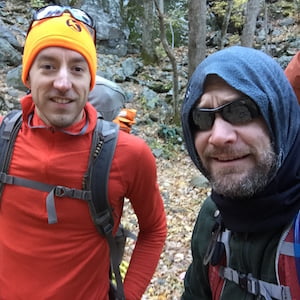
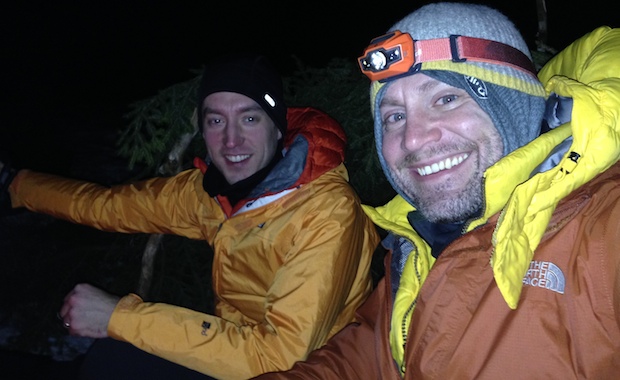
My buddy, Coop, and I have backpacked during the winter months for a few years now. Shining Rock in Western North Carolina, Roan Mountain along the Tennessee-North Carolina border, and most recently Dolly Sods in West Virginia.
We hadn’t traveled north for a winter hike, and it’d be a test for us as Dolly Sods is notorious for year-long crazy weather with an average annual snowfall of 55″. As he always does, Coop researched potential routes and came across White Grass Cross Country Ski Area, a cross country skiing and snowshoeing business in Davis, WV. He emailed Chip, the dude in charge, who kept Coop in the loop about weather and gear (including $15/day snowshoe rental).
Our intent was to park at White Grass and take the Timberline trail to Forest Road 80 where we’d huff it up to 524 Rocky Ridge. From there we’d head east on 511 Blackbird Knob, camp at the intersection of Blackbird and Upper Red Creek, and then head up to Dobbin where we’d join up with Rocky Ridge which would take us back to our car. A fairly straightforward 3-day, 15.5 mile trip. However, thanks to the wintry weather, the actual route we hiked was a slightly different.
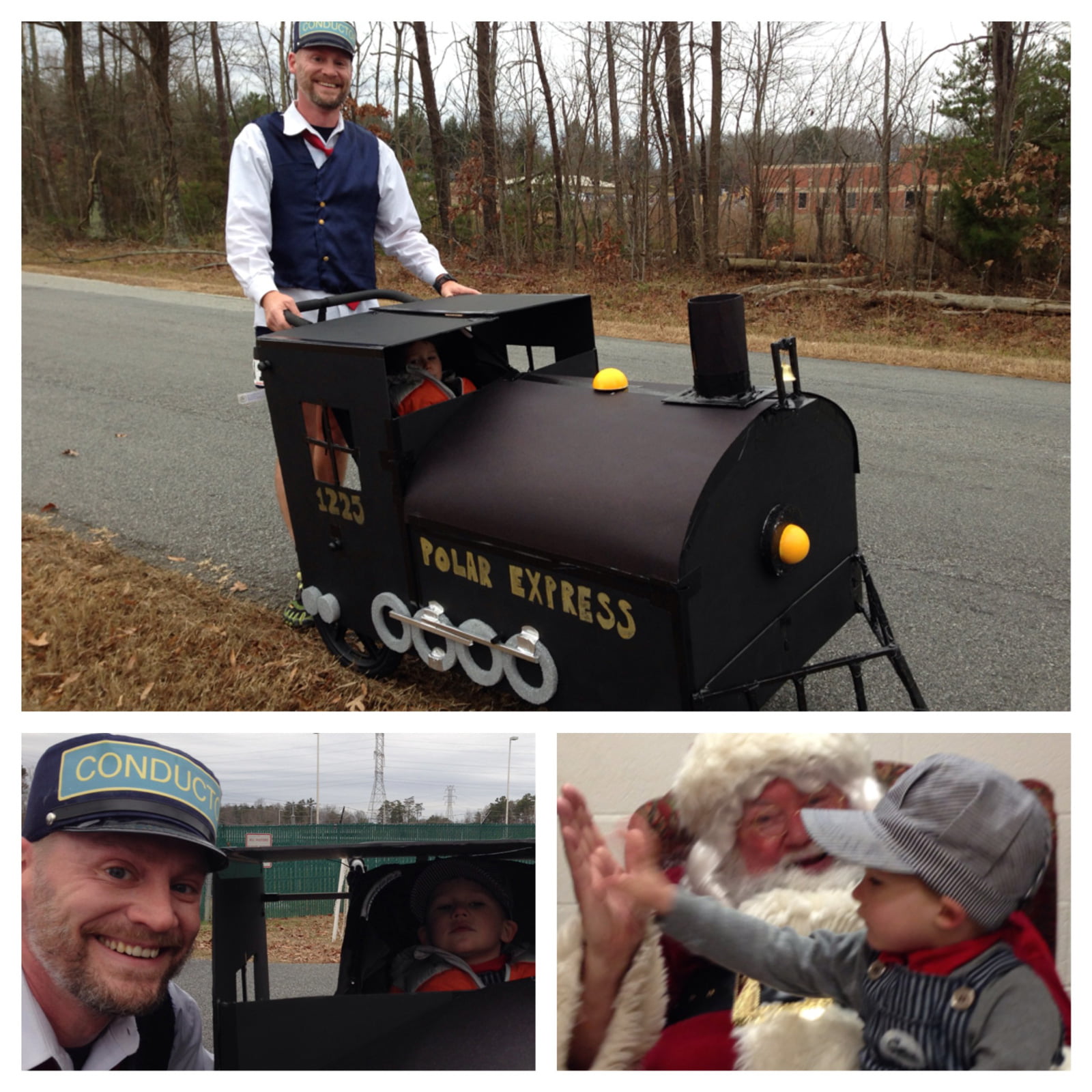
Christmas is a special time of year. Setting up the tree, spreading holiday cheer, and running in a costume in the Reindeer Romp 5K in Jamestown, NC. The tree is easy, my wife and I bought a fake one. Holiday cheer is also fairly easy. The latter, however, is somewhat difficult.
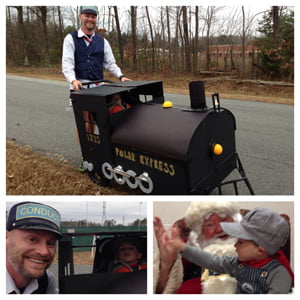
In the past I’ve run as a Christmas present, the Grinch (with a sleigh), and a Christmas tree. This year, I wanted to go as something completely ridiculous (well, ridiculous-er). I thought of something awesome, was all gung-ho, then had to change it due to unforeseen circumstances requiring my son to join in on the fun. So, I asked the little guy what he thought we should make and he went with the one thing he loves more than anything else—The Polar Express.
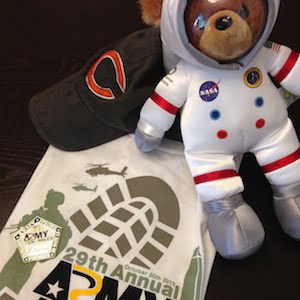
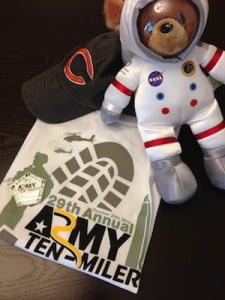
This past weekend I ran the Army Ten-Miler (ATM), a fantastic 10-mile road race in Washington, D.C. that starts and finishes at the Pentagon, passing by landmarks including the Lincoln Memorial, Washington Monument, Jefferson Memorial, and the Capitol Building.
Since the inaugural race in 1985 the ATM has grown from a humble 1,379 finishers to 25,925 finishers in 2013. Nearly 300,000 runners have participated since the race began, and only one man, U.S. Army Col. (Ret.) Lew Goldberg, who has run every Army Ten-Miler since 1985.
While I’m no Lew Goldberg, I have run the race three times before. I ran the race with shoes in 2006 (1:13:05) and without shoes in 2011 (1:17:29) and 2012 (1:12:06). This year, for my fourth running, I opted for Vibrams thanks to my ongoing battle with plantar fasciitis.
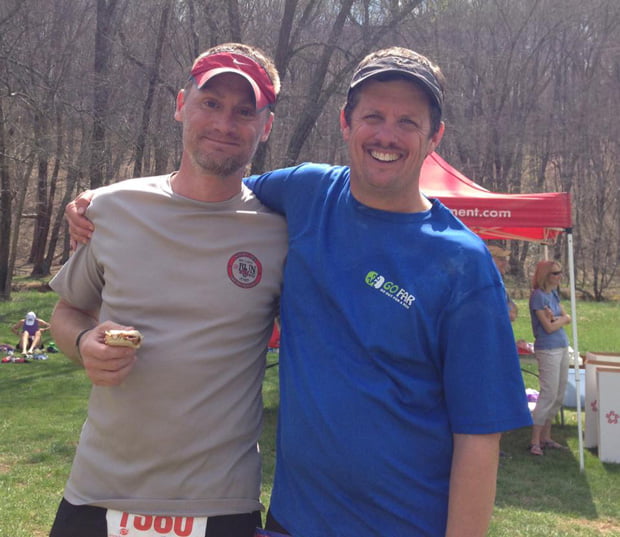
In 2012, my buddy John joined the Blue Ridge Relay GO FAR team. I’d later learn that he was using the relay as a training run for an upcoming ultramarathon. I thought, what an idiot. Then I thought, wait, what’s an ultramarathon?
In short, an ultramarathon is defined as any running event longer than the traditional marathon length of 26.2 miles (42 km). Good gravy, that sounds awful. Yeah, John is definitely an idiot.
After the BRR, John talked me into running the Pilot Mountain Payback Marathon. As we trained for the Payback and as we ran the race, John kept talking about running ultras. Eventually I fell victim to his persuasive tactics and signed on for the Triple Lakes Ultra 40 miler. Then I thought, I’m an idiot.
If you’ve run a marathon, then you’re pretty familiar with how to train for an ultra. You just have to run more. Between May and October I logged 600 miles. Most of my runs were on the road, about 100 miles were on trails, and my longest run was 29 miles. Beyond that, I didn’t do much more to prepare myself. I just ran, a lot.